Agent Systems · 21-c02
26 June 2026 · Architecture reading
Agent architecture is not just attaching tools to a model. It is the control structure that decides when the model reasons, acts, stores state, reads failure, and searches alternatives.
- Axis
- control flow
- Question
- which uncertainty?
- Lever
- feedback + search
- Risk
- cost + loops
Key terms
- ReAct
- Plan-and-Execute
- Reflexion
- Tree of Thoughts
- Graph of Thoughts
- feedback
- search
The previous post defined an agent through goal, state, tools, loops, and termination. This one goes one layer lower: how do different arrangements of the same pieces become different architectures?
The names matter less than the failure modes. ReAct, Plan-and-Execute, Reflexion, Tree of Thoughts, and Graph of Thoughts each address a different way an agent can get stuck.
Architecture
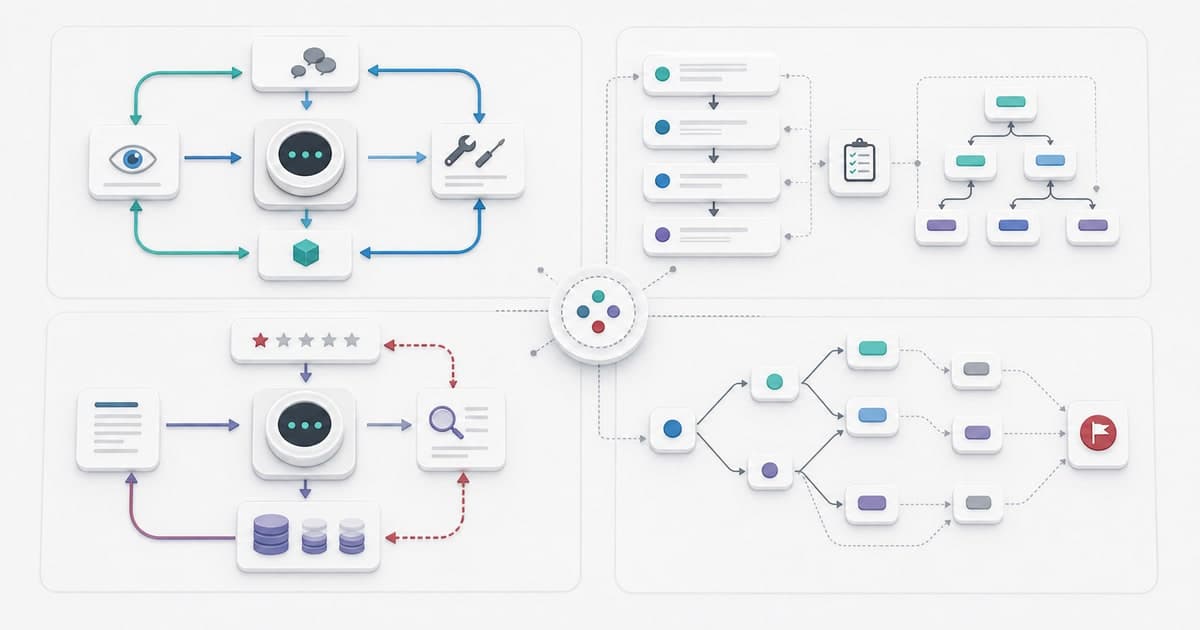
Here, architecture means the decision structure around the model. When does it call a tool? Is the plan made once or updated after each observation? Is failure written into memory? Are multiple solution paths explored?
The same model can behave like an operator in ReAct, a coordinator in Plan-and-Execute, a student in Reflexion, a search process in Tree of Thoughts, or a reasoning graph in Graph of Thoughts.
feedback
Does environment, test output, or evaluator output affect the next decision?
planning
Does the controller decompose the task and dependencies before execution?
memory
Is failure stored in episodic memory for later attempts?
search
Are multiple reasoning paths explored with lookahead and backtracking?
aggregation
Can different paths merge into a shared intermediate result?
ReAct
ReAct puts reasoning and acting in the same loop. The model reasons, calls a tool when needed, receives an observation, and updates the next step.
It is useful when the task lacks information, but every tool call adds latency and a new failure surface.
thought
action
observation
updated thought
Plan-and-Execute
Plan-and-Execute decomposes the task before execution. Plan-and-Solve does this at prompt level; HuggingGPT turns it into model/tool orchestration.
The strength is reducing missing steps. The risk is that a bad global plan can make the whole system execute the wrong thing cleanly.
request
plan
dependencies
execute
synthesize
Reflexion
Reflexion lets an agent learn from failure without changing model weights. Feedback becomes a natural-language lesson stored in episodic memory.
This works best when the environment can provide evaluable signals such as tests; it is weaker when broad exploration is the bottleneck.
deneme
başarı/hata sinyali
doğal dilde ders
kalıcı not
daha iyi hamle
Tree of Thoughts
Tree of Thoughts treats reasoning as search over intermediate thoughts instead of one left-to-right completion.
It helps when lookahead and backtracking matter, but it trades tokens and latency for reliability.
Graph of Thoughts
Graph of Thoughts relaxes the tree assumption. Different reasoning paths can merge, improve each other, or contribute to a shared intermediate result.
This fits tasks that naturally decompose and recombine, but it requires more controller, scorer, parser, and validation machinery.
aggregate / improve / validate
Choosing
Do not ask which architecture is best. Ask where the agent breaks: missing information, missing steps, repeated mistakes, premature commitment, or inability to merge parts.
Reliability is not a model property alone; it is a fit between task and control structure.
Missing information
ReAct
correct with tool observations
Missing steps
Plan-and-Execute
decompose first
Repeated failure
Reflexion
write the lesson to memory
One path is not enough
Tree of Thoughts
search alternatives
Parts must merge
Graph of Thoughts
aggregate and validate
Sources
Agent architectures mature when control flow, state, feedback, search, and validation are combined in a way that matches the task.
So before choosing an architecture, ask what kind of uncertainty the system faces.
Sources
- S1Yao et al., ReAct, ICLR 2023
- S2Wang et al., Plan-and-Solve Prompting, ACL 2023
- S3Shen et al., HuggingGPT, NeurIPS 2023
- S4Shinn et al., Reflexion, NeurIPS 2023
- S5Yao et al., Tree of Thoughts, NeurIPS 2023
- S6Besta et al., Graph of Thoughts, AAAI 2024
- S7Wang et al., Survey on LLM-Based Autonomous Agents, 2025